
What the Term Outsider Art Means
The meaning of outsider art depends on the relationship between an artist and established art-world systems. The term is commonly used for work made beyond, or at the margins of, formal training and mainstream institutions. It does not name a single visual style: works grouped under it may differ in subject, technique, and presentation. The label’s meaning depends on the setting in which a particular artist or work is described.
A working definition
Outsider art is a broad, context-dependent label for art made outside or at the margins of established art institutions and training. It may describe an artist who has not attended art school, has little contact with galleries, or develops a practice independently of professional art networks. These circumstances are not a checklist: an artist may have some formal instruction and still work largely beyond those systems.
The term describes a relationship to the art world, not a fixed medium or visual formula. A painting, drawing, sculpture, or mixed-media work could be called outsider art in one setting, while another work by the same artist might be presented under a different category. Bright color, dense detail, unusual scale, or unconventional subject matter alone cannot establish that classification.
Biography is not a defining requirement either. Some artists associated with the label are self-taught, but lack of training does not automatically make every work outsider art; many self-taught artists exhibit within mainstream galleries and museums. Conversely, an artist’s work may enter a major collection after beginning outside formal institutions. The label describes an artistic and institutional position at a particular time, rather than a permanent identity attached to every work.
Why definitions vary
Historical usage has shaped the phrase. Roger Cardinal’s 1972 book Outsider Art helped establish the term in English-language discussion, but later writers and curators have not applied it uniformly. Some use it broadly for art made beyond the mainstream art world; others reserve it for practices they see as especially independent of professional training or commercial recognition.
Curatorial choices also matter. A museum exhibition may group works by artists who share limited access to formal institutions, while another collection may organize similar works by region, period, or subject. Geography affects the boundary too: training systems, gallery networks, and local traditions differ between countries, so an artist considered outside the mainstream in one place may have a recognized position in another.
Ideas about formal training have changed as well. An artist might begin without academic instruction, later take classes, and eventually exhibit in established venues; descriptions of that career can shift as its circumstances change. Visual appearance and institutional position are separate questions: an unconventional-looking work is not proof of an artist’s background, and a work with familiar techniques can still emerge outside art-world networks. When reading the label, check who is using it, when, and in relation to which institutions or training history.
Art Brut and Related Terms
Art brut and self-taught art describe related but different ideas. One term comes from a specific mid-20th-century art concept; the other describes a maker’s relationship to formal instruction. Both can refer to work made beyond mainstream art institutions, but they do not identify the same artists in every setting. Museums, researchers, and collectors may use each term according to different historical records and curatorial aims. Knowing the distinction helps explain why labels can vary between collections.
Art brut
Art brut is a historically specific term associated with French artist Jean Dubuffet, who began using it in 1945. He applied it to work he saw as made beyond conventional cultural and academic systems, rather than as a style defined by particular materials or visual features. The concept reflected his interest in creative production outside the established art world and its expectations of training, taste, and professional recognition.
Dubuffet’s idea was not simply a synonym for art by someone without a degree. His approach emphasized the perceived independence of the work from prevailing cultural models, and his collection brought together works by makers with varied lives and circumstances. The Collection de l’Art Brut, established by Dubuffet and opened in Lausanne in 1976, gives the term a clear institutional history as well as a broader influence on later collecting and scholarship.
Outsider art became a wider English-language category, and curators have sometimes used it to discuss work related to Art Brut. The relationship is close, but the terms are not exact equivalents: Art Brut refers to Dubuffet’s historically grounded concept, while outsider art has been applied across a broader range of artists, periods, and collections. As a result, a work may be described as outsider art without being classified as Art Brut, depending on the collection’s history and the curator’s terminology.
Self-taught art
Self-taught art describes work made by artists who have not received, or have not chiefly relied on, formal art instruction. The term concerns a maker’s relationship to education, not a single style or historical movement. A self-taught artist may develop skills through observation, books, practice, community knowledge, or informal workshops; the label does not mean the artist has had no contact with other art or ideas.
Art brut and self-taught art can overlap when a maker works outside formal art education and the work is also considered through Dubuffet’s concept. Their different starting points matter: Art Brut has a specific origin in Dubuffet’s 1945 terminology, whereas self-taught art is a broader descriptive term without one founding date. The comparison below shows how the labels serve different purposes.
| Aspect | Art Brut | Self-taught art |
|---|---|---|
| Historical origin | Jean Dubuffet began using the term in 1945. | No single founding date; it describes a relationship to formal art instruction. |
| Main emphasis | Work associated with Dubuffet’s concept of creation beyond conventional cultural and academic systems. | The artist’s education and sources of knowledge, rather than a defined visual approach. |
| Typical usage | Used in historical discussion and in the name and history of the Collection de l’Art Brut in Lausanne, opened in 1976. | Used broadly in biographies, exhibitions, and descriptions of artists without formal art training. |
| Overlap | Some makers described as Art Brut may also be self-taught, but the terms do not have identical scope. | Self-taught artists may work in many contexts and are not automatically classified as Art Brut. |
The distinction is useful when comparing artists or reading a collection catalogue: one label points to a particular historical concept, while the other identifies an educational pathway. Choose the term that matches the context being discussed, and use both only when each description is relevant.
Common Forms and Materials
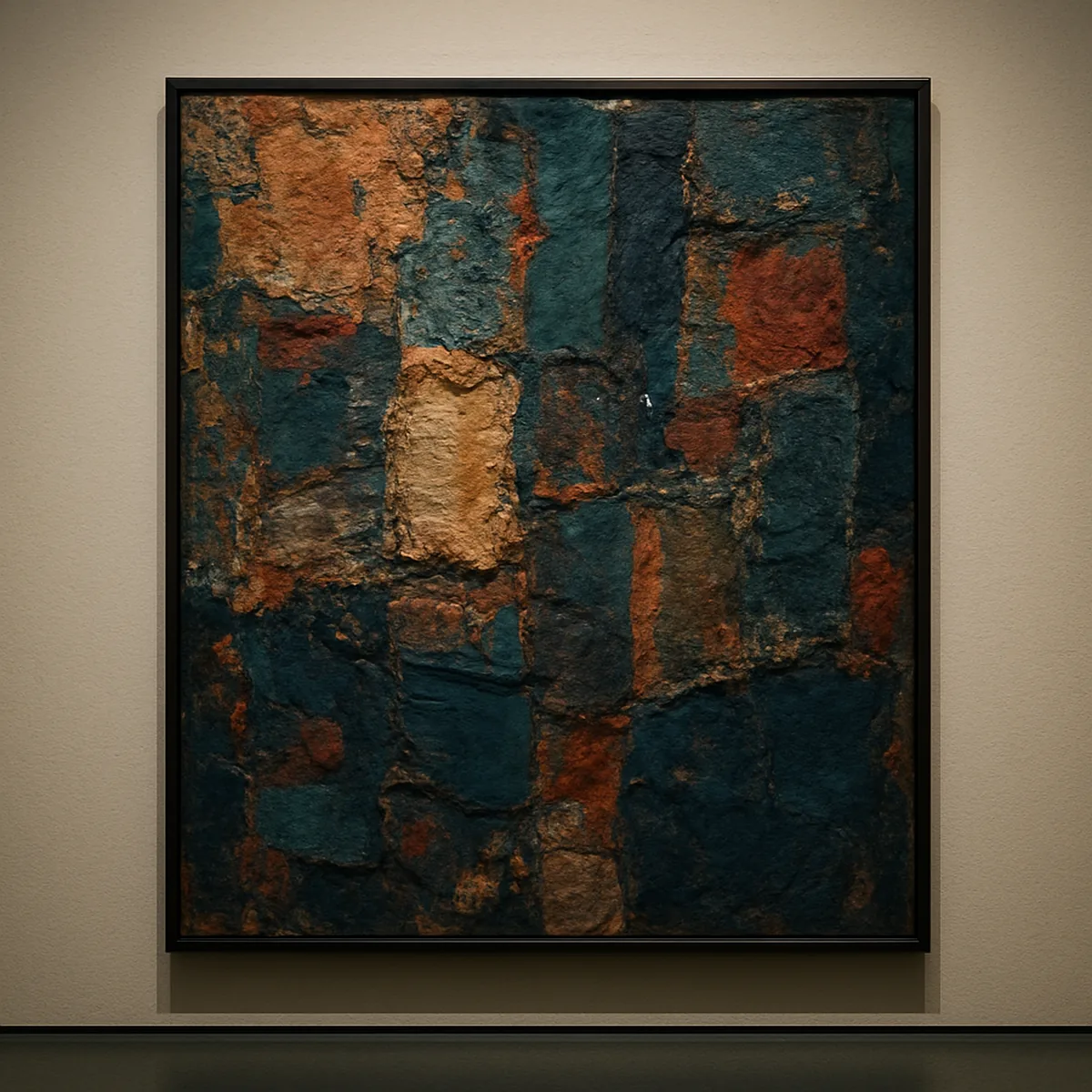
Works discussed as outsider art span intimate drawings, paintings, writing, textiles, sculpture, and room-sized constructions. Some are made with conventional art supplies; others bring together materials already at hand. Methods range from carefully repeated marks to dense accumulations and elaborate personal systems. Materials and appearance offer useful clues to how an individual work was made, but neither alone defines it.
Media and materials
Drawing, painting, sculpture, assemblage, writing, and textile work all appear in art made beyond mainstream institutions. A maker may use a familiar medium in an unconventional way, or combine several media within one piece.
Supports and materials vary with the work, its scale, and what the artist chooses to use:
- Pencil, charcoal, ink, or marker may cover loose sheets, notebooks, cardboard, or reused paper; lines can be tentative, compressed, or meticulously repeated.
- Paint may be applied to canvas, board, paper, or walls with brushes, fingers, or improvised tools; opaque layers and exposed ground both occur.
- Carved or assembled forms use wood, wire, clay, plaster, or other available matter, ranging from hand-sized figures to structures that occupy a room.
- Boxes, packaging, machine parts, and household remnants can be joined, stacked, or arranged, turning discarded objects into deliberately composed three-dimensional works.
- Words, lists, symbols, and number sequences may sit beside images or fill pages, using handwriting, invented notation, copied text, or repeated marks.
- Fabric can be stitched, knotted, patched, or embellished with thread, scraps, and beads; textile pieces may function as images, objects, or room-scale constructions.
These examples describe possibilities rather than a fixed inventory: artists may shift supports or combine paint, paper, fabric, and found objects. No single medium is exclusive to this category.
A work calls for attention to its actual materials and their arrangement: a painted board and a layered assemblage invite different observations, even when both use reused matter.
Working methods and visual forms
Some makers build a work through repetition, covering a page with recurring marks, symbols, or figures. Repetition can create rhythm and density, while small changes between marks make a sequence feel personal rather than mechanically uniform. Other artists accumulate details over time, adding lines, images, or written fragments until a surface becomes a closely packed field.
Invented systems are another approach. A maker might organize images in grids, arrange signs into recurring groups, or develop a private sequence of numbers and symbols. Detailed patterning can follow a visible structure, such as rows or radial forms, or shift across the surface without a regular order. These choices shape how a viewer reads the work, but do not by themselves explain its meaning.
Scale and construction vary just as widely. One artist may work slowly within a small sheet, while another builds a large, layered environment from many connected parts. Some forms are highly ordered; others combine crowded passages with open space, or switch between recognizable imagery and abstraction. There is no single visual formula shared by all makers.
Methods and appearance differ from artist to artist, and a repeated motif or unusual composition cannot establish a work’s category on its own. Look closely at how the individual piece is organized and made: its materials, scale, sequence, and construction together offer a more grounded account of that work.
How the Label Is Applied
An outsider art classification may be assigned in an exhibition catalogue, a collection record, or a later art-historical account; these settings do not always use the same criteria. Artists’ own descriptions can sit alongside terms chosen by curators or collectors, and each may emphasize different aspects of a work. Once used, a label can influence how a piece is grouped, displayed, and discussed. Its meaning therefore depends partly on who applies it and the context in which it appears.
Artists, curators, collectors, and institutions
A label is rarely the product of one decision. Artists, curators, collectors, and institutions each bring different information and priorities to the classification of a work.
- Artists may describe their practice in terms of subject, process, community, or personal purpose. Their statements, interviews, and preferred biographies can clarify how they describe a work.
- Curators select terms for exhibition themes, wall texts, and catalogue essays. A curator grouping works by subject may foreground shared imagery, while another emphasizes each artist’s distinct practice.
- Collectors influence classification through the works they acquire, preserve, and present together. A collection focused on self-directed practice can make that aspect more visible than an artist’s other contexts.
- Museums and archives create catalogue records that name artists, date works, describe provenance, and assign subject terms. Those records can shape how researchers find and compare objects.
- Galleries and exhibition organizers use labels to position works for particular audiences. A show title or checklist may connect an artist with a wider category even when the artist uses another description.
- Art historians place works within accounts of particular periods and networks. Their published classifications can affect whether an artist appears in a specialized discussion or a broader survey.
- Cataloguing teams may retain earlier terminology in records so that historical documents remain searchable. A current description can coexist with a former label, making the record’s date and source relevant.
These choices affect interpretation as well as access: a label may determine which works hang together, what visitors read first, and where a maker appears in a catalogue or survey. Reading the classification alongside the artist’s words and the institution’s record helps show whose perspective it represents.
Context and changing classifications
A classification can shift when a work moves from a private collection to a museum exhibition, or when a later catalogue places it beside different artists. The object may remain unchanged, while the exhibition’s theme, accompanying text, or research changes the terms used to discuss it. A label in a 1980s checklist, for example, records the language of that particular event; it does not necessarily describe how a museum catalogues the same work today. Disagreement can arise because a curator may emphasize an artist’s working circumstances, while the artist’s own account centers on intention, training, or community. Researchers may also question a category when new archival evidence changes what is known about an artist’s education, professional activity, or relationship to galleries. Such findings can prompt a revised catalogue entry or a different place in an exhibition without making earlier records disappear. Terminology is also revisited as art history changes. A collection may retain an older term in a dated record while using a more precise description in a current display, allowing readers to distinguish historical usage from present interpretation. The maker’s stated context and the work itself should remain central when assessing these choices. Treat labels as contextual classifications: check who applied one, when it was used, and what evidence the accompanying record provides.
Questions and Criticisms Around the Category
The category can help describe art made beyond established art-world pathways, but it also raises questions about who is being grouped and why. A shared label may draw attention to independent creativity while obscuring differences in purpose, culture, training, and working conditions. Visual features alone cannot establish an artist’s biography or health. Examining specific attribution, documented context, and the role of institutions makes the label easier to assess critically.
Reducing artists to a category
A broad category can make unlike artists appear interchangeable, even when their reasons for making art and circumstances differ substantially. Specific attribution helps keep those distinctions visible.
- An artist may make work for personal devotion, while another may focus on formal experimentation; one category can conceal these distinct aims.
- Formal study, informal instruction, and sustained independent practice are different experiences, even when artists share limited access to conventional art schools.
- Family traditions, local histories, and community practices can shape imagery in ways that a broad outsider label does not explain.
- Access to materials varies: one maker may use inexpensive household objects, while another has a dedicated studio and archival supplies.
- Time and working conditions matter; a person making art around paid employment has a different routine from someone with uninterrupted studio hours.
- Artists may exhibit, sell, or circulate work through different networks, so grouping them together can obscure their distinct audiences and professional choices.
These differences affect how a work is made and presented. A label that replaces an artist’s name, dates, materials, or stated purpose can turn individual decisions into presumed category traits.
Specific attribution restores detail: identify the maker where known, describe the work itself, and use documented information about its production and circulation. That approach allows comparisons without suggesting that every artist in the category shares one outlook or method.
Reading biography from visual style
Repetition, dense detail, unusual imagery, or an unconventional perspective are visible features of an artwork; none establishes the maker’s personal history or health. The same formal choice can serve different purposes, from planning a pattern to emphasizing a subject.
A repeated motif, for example, can be recorded as a recurring element across several works. It does not by itself prove compulsion, distress, or any other private experience. Likewise, crowded compositions may reflect a deliberate interest in accumulation rather than a biographical condition.
Claims about an artist’s life require evidence separate from visual interpretation. Relevant material may include a dated statement by the artist, a reliable interview, correspondence, or archival records whose provenance can be checked. A curator’s interpretation of a painting is not equivalent to a confirmed account of the maker’s health or circumstances.
When such evidence is unavailable, description should stay close to what can be observed: the work’s repeated marks, layered imagery, scale, or use of space. Even a title or inscription needs context, since it may have been added by someone other than the artist or recorded later.
This distinction protects both accuracy and the work’s complexity. Viewers can discuss how a picture produces an intense or unfamiliar effect without turning that response into a diagnosis or a story about its maker. Biographical claims belong only where dependable documentation supports them.
Power and curatorial context
Museums, galleries, collectors, and critics influence how outsider art is presented and interpreted. A museum label, exhibition catalogue, or sales description can give a category authority, even though the artist may not have chosen that term. The wording and placement of a work affect which parts of its history visitors encounter first.
Curatorial choices shape interpretation through selection and comparison. Placing one artist beside another may emphasize shared materials or visual features, while leaving differences in purpose and background less visible. Labels, wall texts, and catalogue essays also determine whether the artist’s own words, when documented, appear alongside institutional commentary.
Markets add another influence: a category can help galleries and auction houses organize and promote works, while its repeated use may narrow how buyers and audiences perceive an artist. A sales description is written in a commercial setting, so it should not be treated as a complete account of the work’s meaning or history.
Institutions can also preserve works, record provenance, and make artists more visible to audiences. Their interpretations are valuable when they identify sources and distinguish documented facts from curatorial readings. Attention to who assigned a label, when it was used, and whose account is presented makes that influence easier to evaluate.
The category is useful as a provisional description of art made beyond mainstream institutions, but it cannot substitute for close attention to a particular artist. Assess the label alongside the evidence: check attribution and context, and separate documented information from interpretation.